Struggling to translate circuit diagram symbols into clear product specifications? This confusion can cause costly sampling errors and delays with your OEM supplier, setting your project back weeks.
Understanding switch symbols means translating an icon into a specific function, like single-pole or two-way. Since symbols vary by region (IEC vs. ANSI), you must confirm the intended function, rating, and market standard with your manufacturer to get an accurate quote and the correct product.
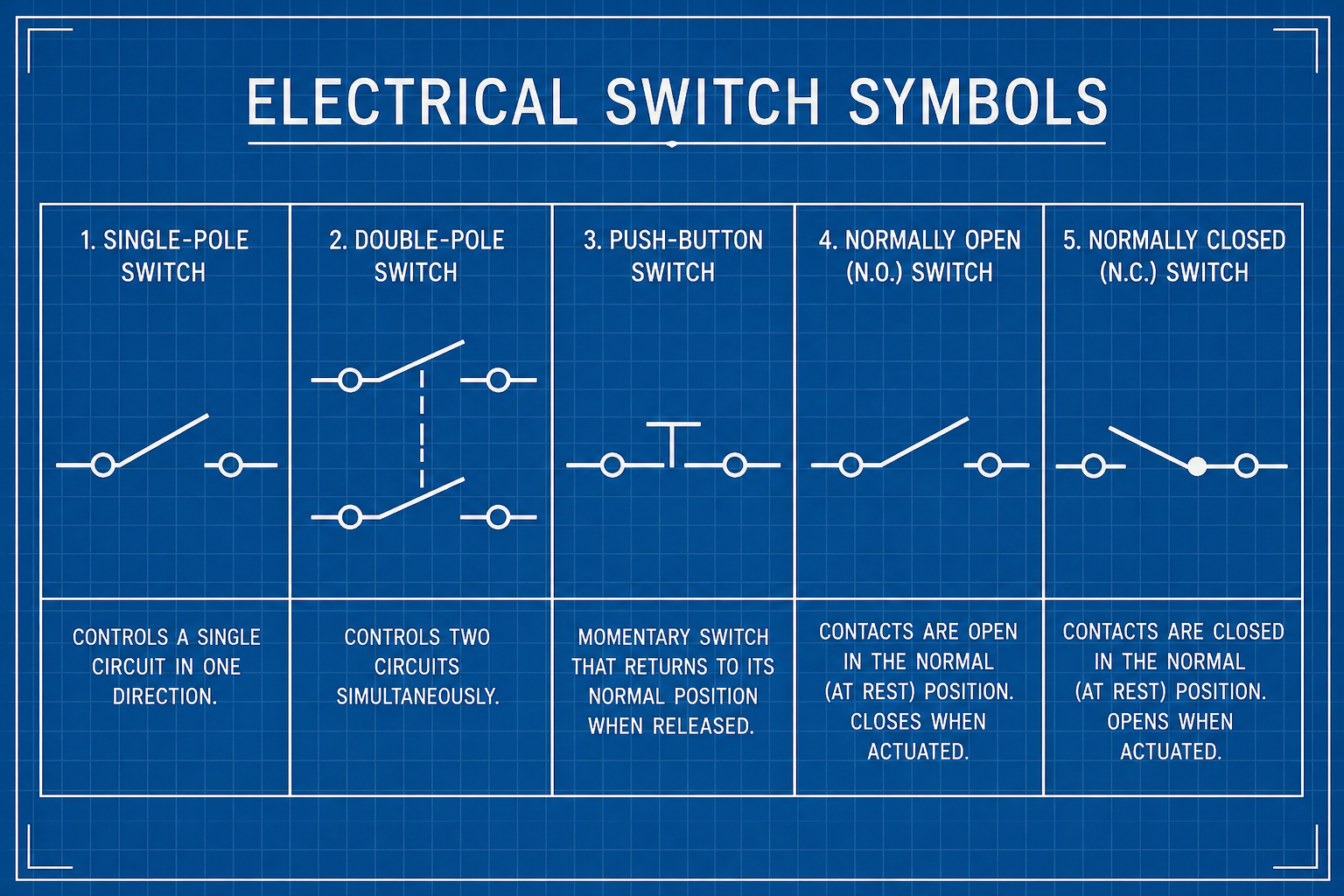
In my experience handling OEM/ODM projects for over a decade, I've seen countless drawings. A symbol on a page is just the beginning of the conversation. The real work is ensuring that both you, the buyer, and we, the manufacturer, understand the exact product that symbol represents. A simple misunderstanding can lead to a pallet of switches that don't work for your market. Let's break down how to move from symbol to specification, ensuring you get exactly what you need on the first try.
Why Aren't All Switch Symbols Universal?
Ever assumed a switch symbol was standard, only to receive a sample that functions completely differently? This common mistake happens when you rely on visuals alone without confirming the underlying standard.
Switch symbols are not universal because different standards bodies, like the IEC (International Electrotechnical Commission) and ANSI (American National Standards Institute), have developed their own conventions.1 Regional drawing habits also create variations, making it essential to verbally confirm the switch's function with your supplier.
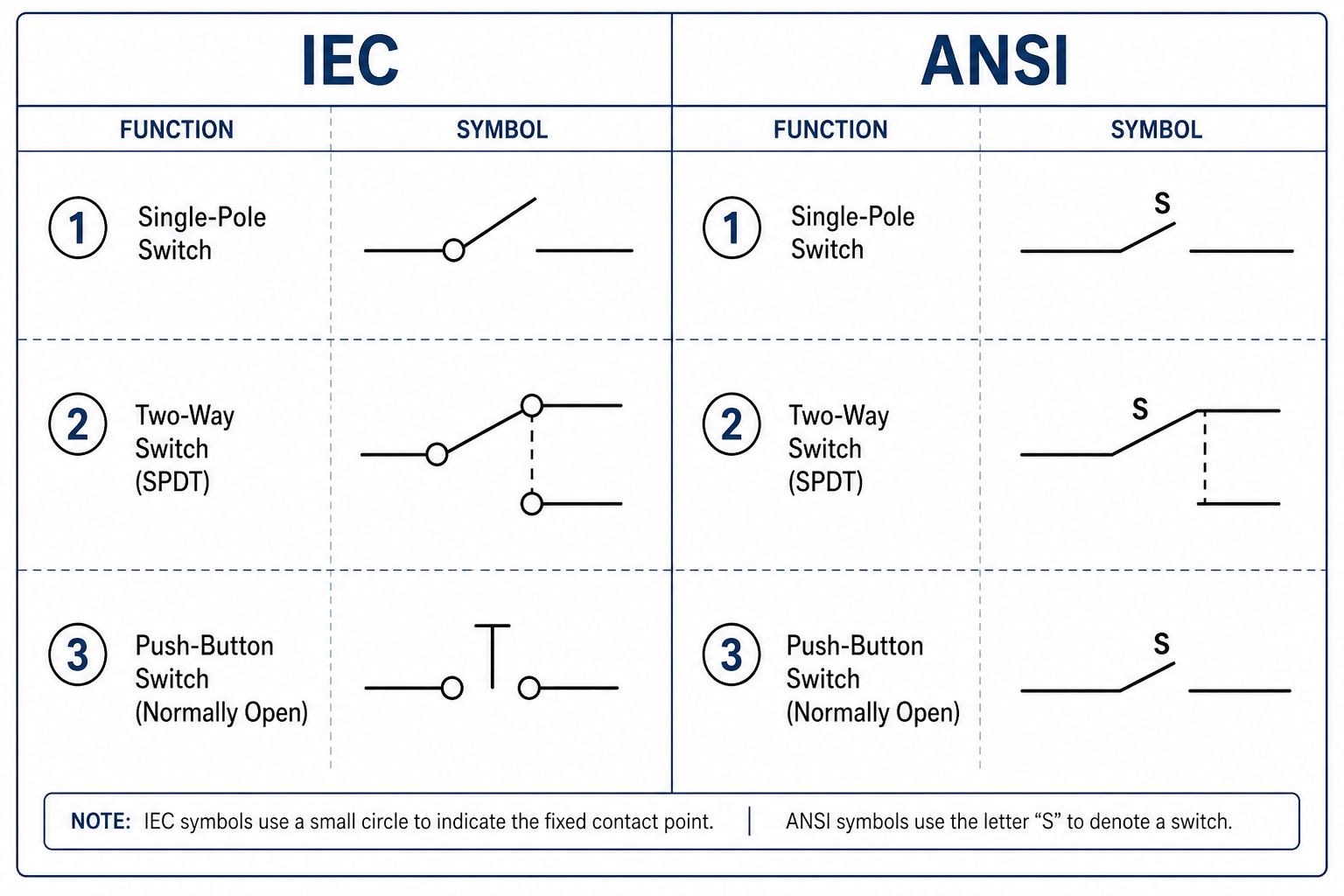
As a manufacturer serving clients in Europe, the Americas, and the Middle East, we see this issue frequently. A drawing from a European client will use IEC symbols, which are common across much of the world. However, a drawing from North America will use ANSI symbols. They often look different for the exact same switch function. For example, a simple one-way switch might be shown with a different line notation. Relying only on the image can lead to misinterpretation. That's why we always ask our clients to confirm the function alongside the diagram.
IEC vs. ANSI/NEMA Standards
The two dominant standards systems create the most confusion. IEC 60617 is widely used in Europe and many other parts of the world, while ANSI/NEMA standards are the norm in North America.2
| Function | Common IEC Symbol | Common ANSI Symbol |
|---|---|---|
| Single-Pole Switch | A line with a break and a small circle | A line with a break and an "S" |
| Two-Way Switch | Two circles with lines showing two paths | A line with a break and "S₃" |
| Push-Button Switch | A line with a T-shaped break | A line with a diamond-shaped break |
This table shows just a few examples. The visual differences are clear. Sending us a drawing with an "S₃" symbol immediately tells us you're likely working with North American standards, but we still need to confirm.
The Importance of a Functional Description
To avoid any ambiguity, always accompany a symbol with a clear functional description. Instead of just pointing to a symbol, state your need clearly: "We require a single-pole, single-throw (SPST) switch rated for 10A at 250V for the UK market." This sentence gives us everything we need: the function (SPST), the electrical rating, and the target market, which implies specific certification and physical form factor requirements. This simple step eliminates guesswork and ensures the first samples we produce are correct.
How Do You Translate Common Symbols into Switch Functions?
You see a circle with lines on a diagram, but what does it actually do in a building? Ordering the wrong switch function, like a one-way instead of a two-way, can make an entire electrical installation unworkable.
A single-pole symbol represents a simple on/off switch for one circuit.3 A two-way (or three-way in the US) symbol allows control of one light from two locations.4 An intermediate symbol is used between two-way switches for control from three or more locations.5
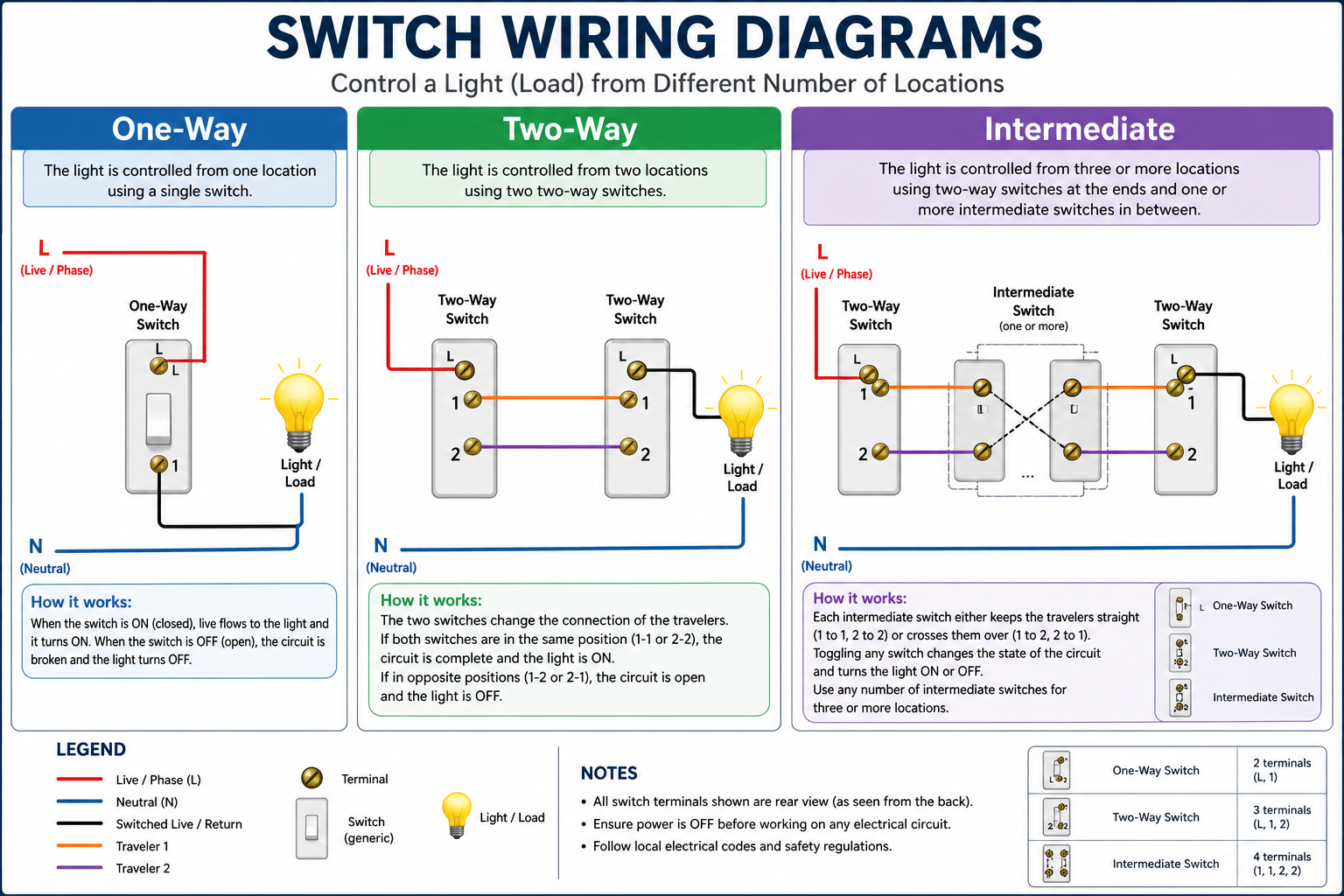
In our OEM/ODM switch projects, we often see buyers provide circuit diagrams where the symbol is clear, but the intended switch function still needs confirmation. The names themselves can even be confusing. What is called a "two-way" switch in the UK is a "three-way" switch in the US.6 This is why we focus on function, not just names or symbols. Understanding what the switch needs to do is the most important step. Let’s look at the most common functions you'll need to specify.
Single-Pole Switches (One-Way)
This is the most basic switch. Its function is to interrupt or complete a single electrical circuit.7 You press it once to turn the lights on and press it again to turn them off. It controls a light or group of lights from one single location.
- Function: On/Off control from one location.
- Technical Name: Single-Pole, Single-Throw (SPST).
- Common Use: Standard light switches in small rooms, closets, or bathrooms. When you send us a diagram with this symbol, specifying "one-way function" confirms its simple on/off purpose.
Two-Way Switches (Three-Way in the US)
This is where communication becomes critical. A two-way switch allows you to control a single light fixture from two different locations.8 Think of a long hallway or a room with two entrances.
- Function: On/Off control from two locations.
- Technical Name: Single-Pole, Double-Throw (SPDT).9
- Common Use: Stairwells, long corridors, large rooms with multiple entrances. When a buyer asks for a "two-way switch," we always clarify the target market. A UK buyer means SPDT, while a US buyer might mean a double-pole switch. Describing the use case—"to control a stairwell light from top and bottom"—is the clearest way to communicate your need.
Intermediate & Multi-Gang Switches
For controlling a light from three or more locations, you need an intermediate switch. This switch is installed in the circuit between two two-way switches. For controlling multiple different circuits from one location, you need a multi-gang switch. This is essentially multiple switch mechanisms housed in a single faceplate.
- Intermediate Switch Function: Used with two-way switches for control from 3+ locations.
- Multi-Gang Switch Function: Multiple independent switches on one plate. When your diagram shows complex switching, it's best to explain the desired user experience. For instance, "This four-gang switch needs to control the main light, fan, wall sconces, and an accent light independently." This tells us exactly how to configure the product.
What Information Should You Provide Your OEM Supplier Besides the Symbol?
You sent a perfect circuit diagram to your manufacturer. But they replied with a long list of questions, delaying your quote. Why wasn't the symbol enough to get started?
Beyond the symbol, you must provide the function (e.g., "two-way"), voltage/current rating (16A/250V), target market (e.g., "Germany"), required certifications (CE, VDE), and desired physical design. This complete picture ensures a fast, accurate quote for a compliant product.
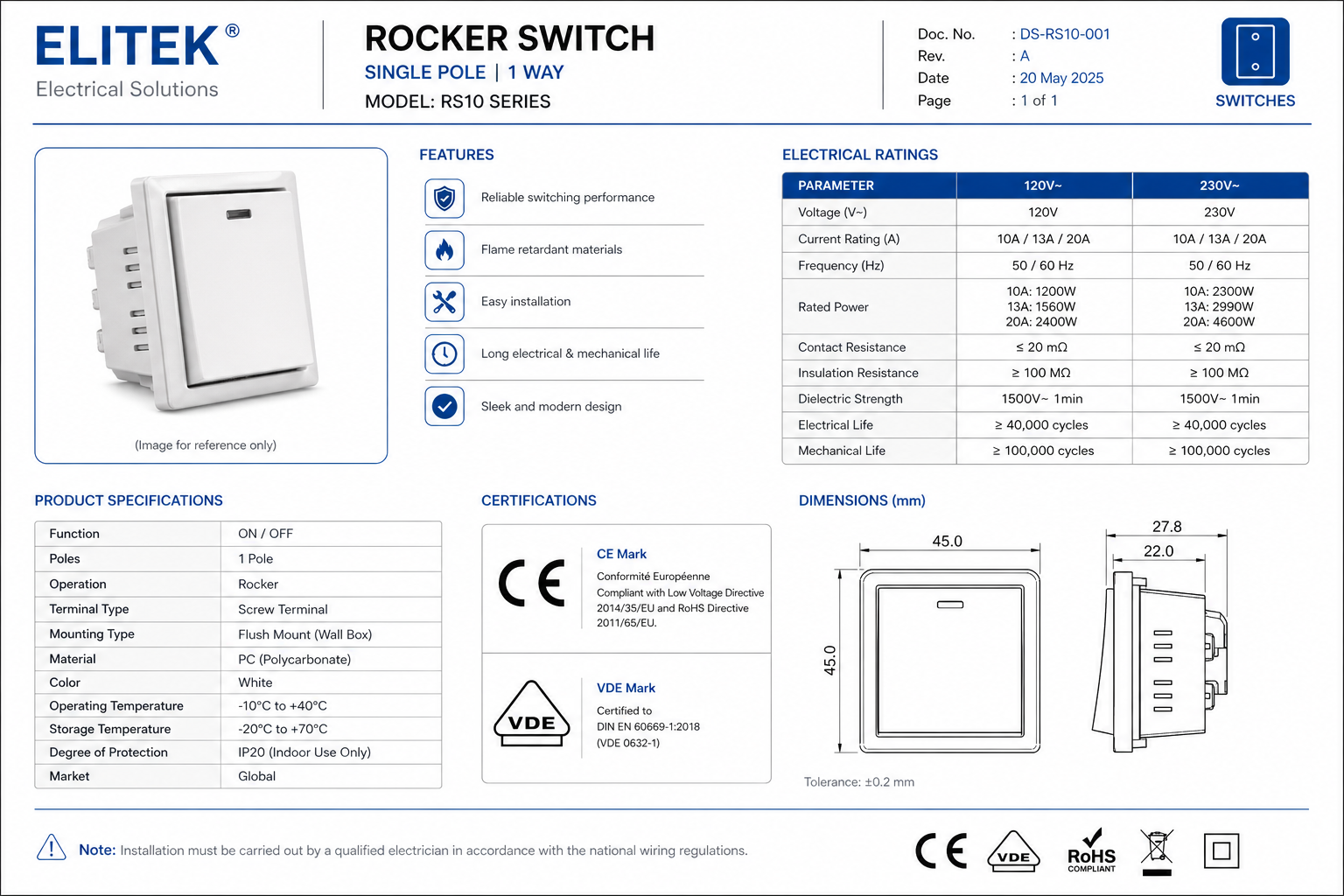
A symbol in a circuit diagram only tells us the intended wiring logic. It tells us nothing about the load it will carry, the safety standards it must meet, or the wall box it needs to fit into. As a manufacturer with 12 production lines, getting these details right from the start is crucial for an efficient production run. In our 12 years of experience, the clients who get the fastest and most accurate service are those who provide a complete technical file, not just a drawing. Let's walk through the essential information we need.
Confirming the Function
As we've discussed, this is the first and most important step. Do not rely on the symbol alone. State the function in plain language.
- Bad Example: "We need the switch in the attached drawing."
- Good Example: "We need a two-way switch (SPDT) to control a light from two locations."
Specifying Electrical Ratings
A switch for a residential light has a very different rating than one for a commercial motor. Providing the voltage and amperage is non-negotiable for safety and performance.
- Voltage: Is it for a 120V system (like in the US) or a 230V system (like in Europe)?
- Current: What is the maximum amperage the switch needs to handle? Common ratings are 10A, 13A, 15A, or 20A. A higher rating generally means more robust internal components.
Identifying Market Standards and Certifications
Every country or region has its own safety standards and required certifications. A product for sale in the European Union must be CE marked.10 A product for the UK often needs BS (British Standard) compliance. A product for Germany might require VDE certification.11 These standards dictate everything from terminal size to material flammability.12 Telling us the target market allows us to select the correct materials and production processes to ensure compliance.
Describing the Physical Product
Finally, we need to know what the product should look and feel like.
- Material: PC, urea, metal, or glass?
- Color: Standard white, or a custom Pantone color?
- Form Factor: What size and shape is the back housing? Does it need to fit a specific type of wall box (e.g., British standard square vs. German standard round)? Providing these details upfront allows us to quote accurately and prepare for manufacturing without delays.
Conclusion
Reading electrical symbols is more than recognizing icons. It's about translating them into clear, complete specifications to ensure you and your manufacturer are perfectly aligned before production even begins.
"[PDF] Typical Electrical Drawing Symbols and Conventions.", https://www.nrc.gov/docs/ML1025/ML102530301.pdf. IEC and ANSI standards documentation shows that electrical and electronic diagram symbols are standardized through separate standards bodies, supporting the claim that symbol conventions can differ by standards system. Evidence role: general_support; source type: institution. Supports: Switch symbols are not universal because IEC and ANSI have developed separate conventions.. Scope note: This supports standards-based variation generally; it may not document every regional drawing habit used in practice. ↩
"[PDF] Typical Electrical Drawing Symbols and Conventions.", https://www.nrc.gov/docs/ML1025/ML102530301.pdf. A neutral standards or engineering reference should identify IEC 60617 as an international graphical-symbol standard and ANSI/NEMA conventions as commonly used in North American electrical documentation. Evidence role: historical_context; source type: institution. Supports: IEC 60617 is widely used internationally, while ANSI/NEMA standards are commonly used in North America.. Scope note: The source may establish regional standards practice broadly rather than quantify adoption by country or industry. ↩
"SPST - Wikipedia", https://en.wikipedia.org/wiki/SPST. An electrical engineering or educational reference defining a single-pole single-throw switch as opening or closing one circuit would support the functional interpretation of a single-pole switch symbol. Evidence role: definition; source type: education. Supports: A single-pole switch represents simple on/off control for one circuit.. Scope note: The source would support the switch function; the exact visual symbol may vary by drawing standard. ↩
"3-way switch circuits -- Variations - Rick Matthews", https://matthews.sites.wfu.edu/courses/p230/switches/3way/variations.html. A building-wiring or electrical reference explaining that two-way/three-way switching uses paired changeover switches to control a load from two locations would support this functional claim. Evidence role: mechanism; source type: education. Supports: Two-way or US three-way switching allows one light or load to be controlled from two locations.. Scope note: Terminology differs by country, so the source should be used to support function rather than universal naming. ↩
"Tutorial: How 3-way and 4-way switch circuits work", http://users.wfu.edu/matthews/courses/p230/switches/SwitchesTut.html. A wiring reference describing an intermediate, four-way, or crossover switch placed between two two-way/three-way switches would support the claim that this arrangement enables control from three or more locations. Evidence role: mechanism; source type: education. Supports: Intermediate switches are used between two-way switches to control a load from three or more locations.. Scope note: The source may use regional terminology such as four-way rather than intermediate, so the citation should clarify equivalence by function. ↩
"Multiway switching - Wikipedia", https://en.wikipedia.org/wiki/Multiway_switching. A neutral wiring terminology reference comparing UK two-way switching with US three-way switching would support the claim that different names are used for the same two-location lighting function. Evidence role: definition; source type: education. Supports: UK “two-way” switching is commonly referred to as “three-way” switching in the United States.. Scope note: The citation supports common terminology equivalence, not necessarily every manufacturer’s naming convention. ↩
"Circuit breaker - Wikipedia", https://en.wikipedia.org/wiki/Circuit_breaker. A basic electrical reference defining a switch as a device that makes or breaks an electrical circuit would support the explanation that a simple switch interrupts or completes a circuit. Evidence role: definition; source type: encyclopedia. Supports: A basic switch operates by interrupting or completing an electrical circuit.. Scope note: This supports the general operating principle and does not address product-specific ratings or construction. ↩
"[PDF] 3 and 4 Way Switches - Electric Level 5 - Purdue University", https://extension.purdue.edu/4-H/_docs/projects/electric/Level5-3-way--4-way-switches.pdf. A wiring textbook, university extension, or public electrical-safety reference explaining two-location light control with two-way/three-way switches would support this description of the switch function. Evidence role: mechanism; source type: education. Supports: A two-way switch arrangement can control one light fixture from two different locations.. Scope note: The source may describe the circuit using country-specific nomenclature rather than the article’s preferred term. ↩
"SPDT - Wikipedia", https://en.wikipedia.org/wiki/SPDT. An electronics reference defining a single-pole double-throw switch as one common terminal connecting to either of two output terminals would support the technical classification of a two-way switching mechanism. Evidence role: definition; source type: education. Supports: A two-way switch mechanism is technically a single-pole, double-throw contact arrangement.. Scope note: The definition supports the contact arrangement; building-wiring implementations may add regional wiring practices and terminology. ↩
"EU Legislation and CE Marking - International Trade Administration", https://www.trade.gov/country-commercial-guides/eu-eu-legislation-and-ce-marking. European Commission guidance on CE marking would support the claim that many products placed on the EU market must carry CE marking when covered by applicable EU harmonisation legislation. Evidence role: expert_consensus; source type: government. Supports: Products covered by applicable EU rules must be CE marked before being placed on the EU market.. Scope note: CE marking is mandatory only for product categories covered by relevant EU legislation, so the citation should not be read as applying to every possible product without qualification. ↩
"VDE e.V. - Wikipedia", https://en.wikipedia.org/wiki/VDE_e.V.. A VDE or German conformity-assessment reference could show that VDE marks are used to demonstrate tested electrical safety for products in Germany, supporting the claim that German-market projects may require VDE certification. Evidence role: general_support; source type: institution. Supports: Electrical products intended for Germany may require or benefit from VDE certification depending on product type and market requirements.. Scope note: VDE certification is often market- or customer-driven rather than universally mandated by German law for every electrical product. ↩
"[PDF] Flammability Of Plastic Materials Used In Portable Electrical ...", https://www.cpsc.gov/s3fs-public/pdfs/foia_flammability.pdf. An electrical product standard or certification reference specifying requirements for terminals, insulating materials, and flammability would support the claim that safety standards affect both electrical connection design and material selection. Evidence role: general_support; source type: institution. Supports: Electrical safety standards can specify design requirements including terminal characteristics and material flammability.. Scope note: Specific requirements vary by product category and standard, so the source would support the general relationship rather than every listed design feature for all switches. ↩